Do you have a teacher you are thankful for?
I know I do.
The one who comes to mind today is my 10th grade math teacher, Mr. Scheib.
I had always enjoyed math and done well in it—until the third quarter of sophomore year. My mother took a second shift to help make ends meet. That meant she was no longer home in the evenings. And that meant I started hanging out with my friends at night rather than studying.
Then I got a math test back with a 70.
Most days when the bell rang at the end of class, I would just get up and go to my next class. But not that day. Mr. Scheib came over to my desk and asked if I had a minute.
“Look,” he said, “I don’t know exactly what’s going on, but I know you’re capable of more.”
This brief conversation was just a mere blip in time. But those words ignited my motivation and soon became a mantra. I recommitted to studying and got my grades back up. I later continued on to AP Calculus, and I joined the math team my senior year.
To this day, I’m grateful to Mr. Scheib for believing in me.
So, when I joined the Concord Consortium as the first Director of Development in September, one of the first things I did was donate to the Future of Learning Fund to honor him.
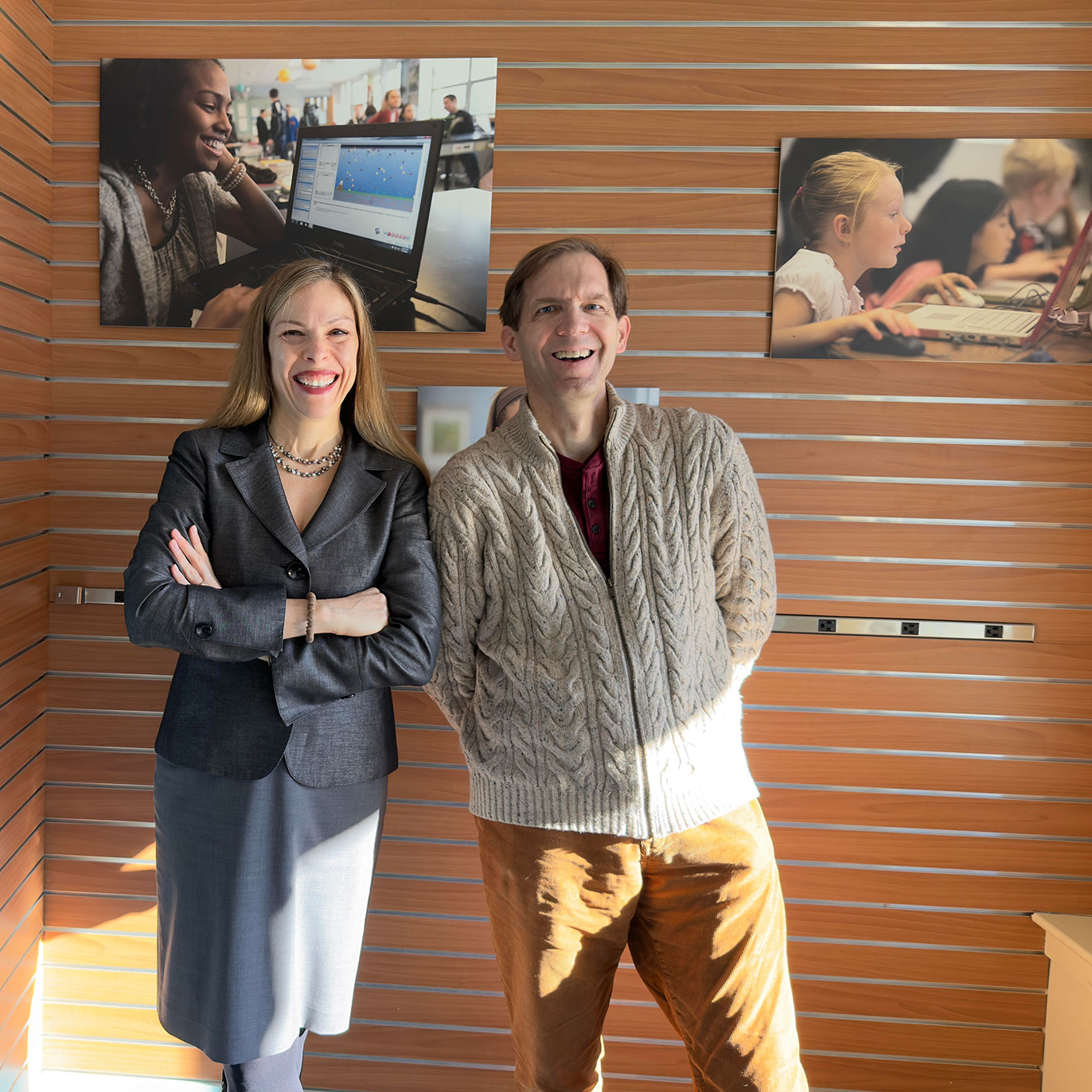
Here I am in our Concord office with Chad Dorsey, President and CEO of the Concord Consortium.
Our mission
For more than three decades, the Concord Consortium has been helping students see themselves as capable of more in science, technology, engineering, and math by making the abstract visible and the complex understandable.
Today’s students must learn entirely new skills while still building the same foundational ones that mattered 35 years ago when I was in high school. As the parent of a seventh-grader, I’m seeing this seismic shift unfold in real time. Educators face an enormous challenge: preparing students for a world shaped by technology while nurturing what makes us beautifully human—inquiry, curiosity, creativity, motivation, and the fundamental need to contribute to something greater than ourselves.
Teaching students both new concepts and new technologies (including the brave new world of AI) requires not just new tools, but new ways of thinking about teaching and learning. To effectively meet this moment, teachers need trusted partners to help them adapt their instructional resources, ongoing professional learning, and communities where they can share ideas, test new strategies, and support one another.
This is where we at the Concord Consortium come in.
Standing at the forefront of data science education, inquiry-based learning with STEM models and simulations, and AI in education, we immerse ourselves in the future of learning communities and then work side by side with teachers to design digital resources in the context of teachers’ and students’ day-to-day realities. We present at conferences throughout the country, facilitating opportunities for teachers to come together to try new models and simulations, share experiences, reflect on student work, and deepen their understanding of inquiry-based STEM learning. We publish our findings on what works and we freely share our tools and resources on our website learn.concord.org.
This Giving Tuesday, I aim to recognize those who make our work possible:
- Over 100,000 teachers representing all 50 states and around the world actively using our free library of over 375 resources at learn.concord.org to engage over 1.5 million learners.
- The teachers and students participating in our 24 active projects as we work to develop and research new educational materials to meet this moment.
- The Valhalla Foundation, the Cisco Foundation, the George Lucas Educational Foundation, the National Science Foundation, and the U.S. Department of Education program staff and reviewers who have helped make our work possible this past year.
- Each of our 12 board members for donating their time, expertise, and personal resources to our work.
Thank you for believing every student deserves powerful tools to explore their world.
Making a gift
We cannot do this work alone. As a nonprofit organization, every dollar we raise goes directly into advancing rigorous research, freely and widely sharing our evidence-based digital tools, and supporting the educators who bring meaningful STEM learning to life. We invest in what works — in technologies that deepen student inquiry, in models and simulations that make complex ideas accessible, and in communities of practice that strengthen STEM teaching and learning.
If our mission resonates with you — if you believe that every student deserves the opportunity to investigate the world with powerful tools, or that teachers should have research-backed resources that honor their expertise — I hope you’ll consider making a gift today. We gratefully accept gifts by check or online, through DAFs, and with assets such as stock or cryptocurrency. I welcome the opportunity to discuss how to best recognize your generosity.
Thank you for the many ways you support educators, students, and innovation in STEM learning.