Category: Author: Dan Damelin

The Concord Consortium is thrilled to partner with PhET in their new data fluency initiative. PhET’s free research-based simulations engage students in a game-like environment—and importantly, the sims generate data. While most of PhET’s traditional physics simulations are idealized models without noise or measurement error, new sims include real-world variability. This means the data they […]

To ensure that blind and low-vision (BLV) learners can engage meaningfully in data science education, we’re designing an AI-supported natural language plugin for CODAP called DAVAI (Data Analysis through Voice and Artificial Intelligence). Students use voice or typed input to ask questions about datasets in CODAP, then get dynamically generated descriptions and optional sonification—hearing the […]
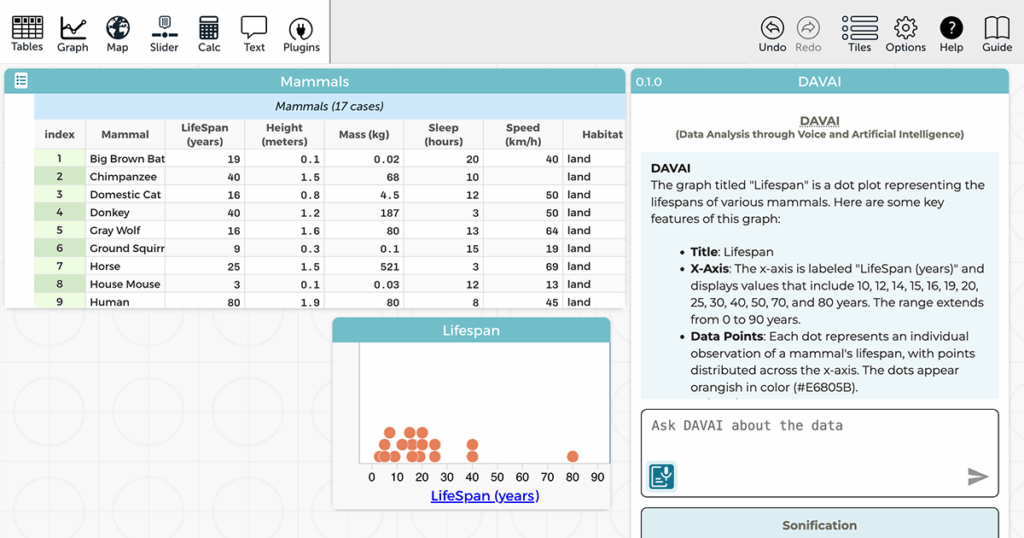
Our Common Online Data Analysis Platform (CODAP) engages learners in data science practices, including data analysis and visualization. But what does “visualization” mean to blind or low-vision (BLV) learners? A new National Science Foundation-funded project is using artificial intelligence (AI) to develop and research new tools for making data exploration accessible to BLV learners. Graphs—and […]
For 14 years I was a teacher at Lincoln-Sudbury Regional High School. Today is the first day of summer vacation for my friends and colleagues there. Now I work at the Concord Consortium, but I remember fondly that day when all the grades had been turned in and “vacation” began. I usually took a couple […]