Electron Technologies
By engaging students with advanced computational models of electron behavior, this project fosters the fundamental understandings students require for careers in areas such as nanotechnology, photonics, and materials science.
Project Portal
View and launch our full set of activities for this project at the Electron Technologies portal.
The interactions of electrons with matter have great explanatory power and are central to many technologies from transistors, diodes, smoke detectors, and dosemeters to sophisticated imaging, lasers, and quantum computing. A conceptual understanding of the interactions of electrons in general allow students to acquire conceptual understandings that they can apply to a very broad range of technologies.
In the Electron Technologies project, we're working with Parkland College, and four ATE Centers (NANO-LINK, BIO-LINK, MATEC, and OP-TEC) to develop approximately 16 field-tested interactive computer-based learning units addressing core content and technical applications such as nanotechnology, photonics, electronics, materials science, biotechnology, and chemical engineering. In addition, the project will create accompanying models intended for use by an online community of educators to create, customize, post, and critique additional model-based learning activities.
Project Partners
Share This
Activity Spotlight
Introduction to Quantum Mechanics
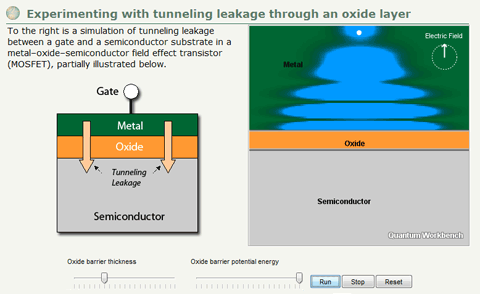
Discover the quantum nature of electrons including their wave nature, tunneling abilities, and their bound and excited states.
Learn MoreIn the Electron Technologies project, we're researching questions related to three prior findings in a prior project entitled MoLit that are of importance to the field of technical education:
- Our research indicated that the approach taken in MoLit better enabled students to transfer core science content to technical areas.
- Our research identified examples in which students provided correct responses on the basis of reasoning about the interactions of atoms and molecules.
- Our research also found 4- to 8-month retention of key concepts, presumably because the modeling environments were vivid and stimulated thoughtful reflection. This combination of transfer and long-term retention implies that the approach was particularly effective and that students should be able to apply the concepts they acquire into the workplace.
In the Electron Technologies project, we will examine these initial findings and determine whether they hold for the new content.
We will also study:
- Whether an understanding of core science content transfers to novel technical contexts, and
- Whether there is long-term retention of project content.
We're developing curriculum in three separate areas, as shown below. The listing below describes a number of activities currently developed. To preview and launch these activities, visit the project portal.
- Introduction to quantum mechanics
- Electrons in atoms and molecules
- How electrons move
- Phenomenon activities
- Plasma
- Electrical conduction
- Quantum tunneling effect
- Semiconductor
- Redox
- Application activities
- The scanning tunneling microscopy
- Transistors
- Fluorescence-activated cell sorting
Activity Spotlight
Introduction to Quantum Mechanics
Discover the quantum nature of electrons including their wave nature, tunneling abilities, and their bound and excited states.
Learn MoreLinks for Teachers
Other Materials
Technology Requirements
Full access to all of the Electron Technology materials requires computers running Windows, OS X, or Linux, with the following software installed: Java 1.4+ and a PDF reader. If you experience technical difficulties running the activities, contact Dan Damelin - ddamelin@concord.org.