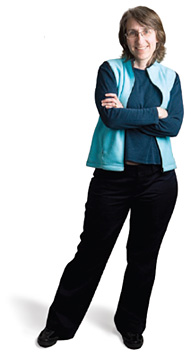
Innovator Interview: Frieda Reichsman
 Q. What brought you to the Concord Consortium?
A. I was a postdoc at UMass Amherst, studying cell-to-cell communication in the fruit fly embryo. One day, across a crowded lab, I spotted my first 3D molecule on a computer screen and fell in love! After working with Eric Martz, an international leader in molecular visualizations and a terrific mentor, I created a company called Molecules in Motion to create visualizations for textbooks and online courses. Dan Damelin found my work, then I consulted on the Science of Atoms and Molecules project and joined the Concord Consortium in 2008.
Q. You have a Ph.D. in Molecular and Cellular Biology. How did you decide to study science?
A. I had always wanted to teach, but what made my day was team practice for varsity basketball, volleyball, and lacrosse. I became a department co-chair of Recreational Arts — a fancy name for gym class — at a K-12 school. My goal was to make class collaborative and fun. When I enrolled in an exercise science program at UMass Amherst, I discovered I needed coursework in chemistry, physiology, and math. I found myself taking all the courses I had feared in college. The first math course was taught by a veritable poet of math. I loved it. I had a similar experience with chemistry and statistics. I kept being drawn back to the molecular level where I could get answers to my questions about how stuff worked. I discovered that although science had seemed hard and incomprehensible, it actually made sense and is quite beautiful.
What makes the Concord Consortium unique?
A. The Concord Consortium has the same appreciation for the beauty that becomes so apparent when you understand science at a deep level. And it’s coupled with cool technology, which I love, not to mention incredibly creative, thoughtful people.
Q. Can you describe the projects you’re currently working on?
A. I had come across Paul Horwitz’s dragons online, so it’s amazing that I now get to lead two projects that focus on dragon genetics! The software brings to life both simple patterns of heredity and much more complicated ways traits are inherited. In GeniGames, we’re investigating the effect on student motivation and affect when we incorporate various gaming aspects into Geniverse.
The Rhode Island Technology Enhanced Science project allows middle school and high school teachers to attend summer trainings to learn how to use our Investigations software, in which we can embed many different models, simulations, and sensors.
I’m also working on a new project with Joe Kracjik at Michigan State University and others at the University of Michigan. Joe’s been a pioneer in teaching inquiry-based science and scientific argumentation. Our goal is to develop interdisciplinary activities that help students visualize and understand the electrostatic forces that shape their world, and to explore how their learning unfolds over time.
Q. What do you like to do outside of work?
A. I bowl nearly every weekend with my 75-year-old friend and neighbor, Nancy, who routinely thrashes me. I used to be a softball pitcher so I thought I’d be pretty good at bowling, but it turns out that candlepin bowling is really hard. The pins are skinny and far apart, and they’re approximately the same mass as the ball, so you find out just how vexing physics can be!